


Suzanne Stewart
Staff Writer
One of the drawbacks – or assets, depending on who you ask – to living in Pocahontas County is the National Radio Quiet Zone which prohibits cellphone towers in the proximity of the Green Bank Observatory.
Of course, there are cell- phone towers in the county, but they don’t cover every inch of the third largest county in West Virginia.
Those cellphone towers do enable communication in some areas, but what happens when there’s no power? When there is a disaster? How do organizations and communities communicate without cellphones, internet or landlines?
They call on the 8 Rivers Amateur Radio Club.
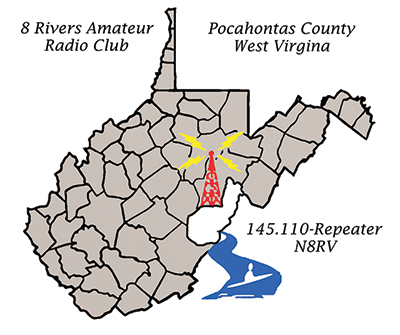
Members of the Ham radio club are all FCC licensed and have the ability to cover almost all of Pocahontas County. The club provides a two-pronged coverage – they are there when there are emergencies or disasters, as well as for events such as the Great Greenbrier River Race and marathons, when individuals are out on their own in areas where cellphones do not work.
“I think people are aware that we are vulnerable here,” club treasurer Jan Cozart said. “During emergencies, it’s key to have communication with emergency services, so that’s where we come in.”
Cozart and her husband, Rudy Marrujo, first got interested in Ham radio when they lived in California.
“We were actually at a gas station, ready to fill up, and there was an earthquake and the electricity went out,” she said. “That was one of the things that spurred us to start looking into Ham radio in California. Just the idea of what do we do in an emergency? You shouldn’t think that you’re going to go through life and not experience something.”
Marrujo moved to Pocahontas County in 2013, and Cozart in 2015. When they got settled into their home in Green Bank, they sought out the radio club and became active members.
Now, the club is seeking help to make its coverage of Pocahontas County complete. They have repeaters throughout the county that they use for communication, but those towers don’t currently cover northern Pocahontas County.
“The northern part of the county is a sticking point, and this project is to remedy that,” Cozart said.
Marrujo and Marty Bloss did an assessment to determine what the club needed to patch in the northern end of the county and came up with a project to install a repeater and a power supply in Bartow. The project will cost a total of $5,000.
“Richard and Marcia Laska have graciously offered for us to locate our repeater on their property and it’s on a high peak,” Cozart said. “It’s ideal for this.”
Admittedly, the club is full of resourceful individuals who could possibly rig something up with parts they have in their garages, but Cozart said that covering the entire county is so important, they want to be assured the equipment is top notch.
The equipment is important not only for emergencies – such as the 1985 and 1996 floods or the Derecho in 2012 – it’s for local events that attract visitors from around the world.
“The Great Greenbrier River Race, trail fest, the scenic mountain triathlon – we provide communications for those,” Cozart said. “We’re stationed out there along the trail to provide communication in case there is an emergency. If someone’s been injured or in case someone wants to drop out of the race.
“We want them to go home and say what a great time they had and that they want to do it next year,” she added.
In her time as a member of the radio club, Cozart can’t think of a single instance when the club said ‘No’ when asked to help with anything in the county.
“Basically, we’re ready to step up to the plate, but we need help,” she said. “We need equipment and we need some financial help to buy that equipment.”
When there is a disaster in the county and the power is out for a long period of time, the radio club is there to help assist emergency services and members of the community communicate and make sure everyone is safe.
“I think, here, we are vulnerable because we have lots of waterways, but we have a lot of vulnerable people in our community,” Cozart said. “It could be from infants to the elderly and anything in between, too. When you don’t have supplies or electricity for medical devices, then that becomes dangerous.
“[Ham radio] can be saving; it can be a lifeline,” she continued. “Our members are good people who would be anxious to step up and do what needed to be done.”
Cozart is in the process of giving presentations to local organizations about what the radio club does and asking if they would be interested in making a donation to help purchase the repeater. The visits have been positive, and the club has secured donations from the Durbin Lions Club and Marlinton Rotary.
“I think it’s important that as a community – and by that, I mean the county – people know that [the club] may be behind the scenes at events, but we’re there,” she said. “I’m anxious for people to recognize what 8 Rivers Amateur Radio Club is and does.
“I also think it’s important for people to know that in the event of if/when an emergency happens, that one of the first things they think about, hopefully, will be our amateur radio operators,” she continued. “We will be on the airwaves for sure.”
Individuals or organizations interested in making a donation to the 8 Rivers Amateur Radio Club Repeater Project may contact Jan Cozart at 304-456-3057.

